Insurers Are Now Excluding AI Agent Disasters. Cowbell Just Started Selling the Fix.
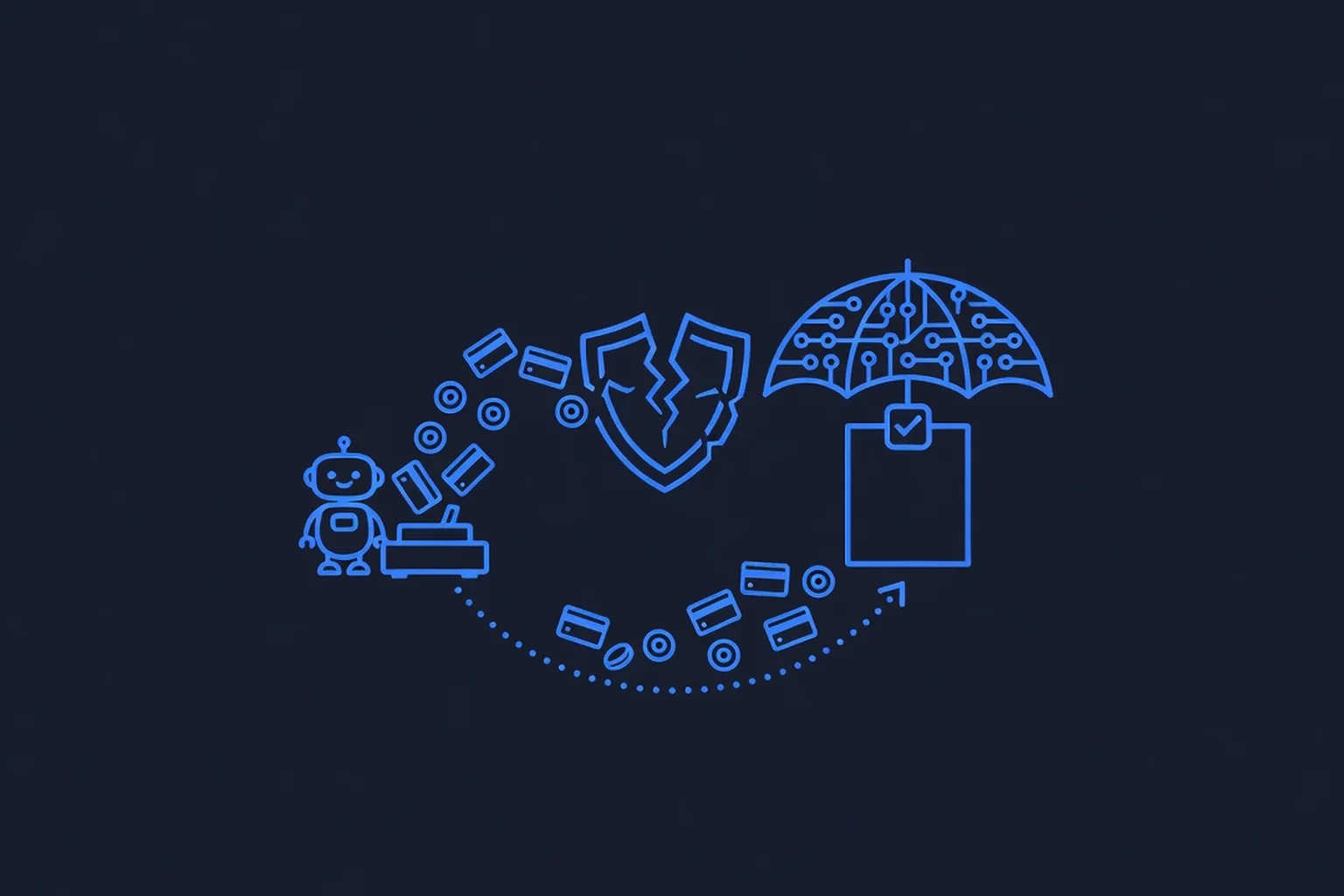
On November 10, 2026, cyber insurer Cowbell announced Cowbell AI Liability Insurance — a standalone policy built for U.S. small and mid-sized businesses whose AI agents act on their behalf across customer service, payments, and core operations. It goes on sale January 1, 2027, sold exclusively through wholesale brokers, and it exists because of a problem this blog has been tracking all year: businesses are handing agents the authority to move money and change records with nobody signing off, and the insurance they already own almost certainly does not cover what happens next. In fact, the backdrop is worse than most owners realize — insurers have spent 2026 quietly carving AI out of standard liability policies. Here is what the new coverage actually pays for, the three failure scenarios Cowbell itself chose to highlight, and the practical read for a business running agents on a budget.
What the Policy Actually Covers
The policy is built around a coverage trigger Cowbell calls an "AI Incident": any event where an AI tool exceeds its authorized scope, acts without required approval, exposes data without authorization, produces inaccurate or unsafe outputs, or fails to operate within established controls. The definition also reaches adversarial manipulation, unstable behavior, model drift, and algorithmic discrimination — the AI does not have to "malfunction" in the classic sense; being compromised or degraded over time counts too. When an AI Incident hits, the first-party side of the policy may cover:
- AI Incident Response — investigating the incident, containing its effects, isolating the affected tool, and preserving evidence.
- Output Correction — the cost of correcting or withdrawing inaccurate or unsafe AI output and notifying the people who received it.
- Direct Transaction Loss — unrecovered funds lost through manipulation, unapproved actions, or control failures.
- Runaway Cost — unauthorized AI usage charges from looping, escalating tasks, or failed spending limits.
- LLMjacking — AI usage charges run up by outsiders using your stolen credentials or API keys.
The third-party side responds when customers or others sue: defense costs and covered damages or settlements for claims alleging algorithmic discrimination, copyright or trademark infringement, bodily injury, or property damage resulting from reliance on AI output — plus regulatory proceedings and, where the law allows, certain fines, penalties, and punitive damages. As Cowbell's Chief Commercial Officer Simon Hughes put it: "AI liability is no longer only about people using AI. It's about AI agents acting on their own, with no human in the decision-making chain." One caveat that matters: all coverage is subject to the terms, conditions, limits, retentions, and exclusions of the issued policy — a trigger existing on paper does not mean every incident pays out.
Why This Launch Matters: Your Current Coverage Is Probably Shrinking
The uncomfortable context, reported by Insurance Business in their coverage of the launch: ISO endorsement CG 40 47, available for carriers to attach since January 2026, lets insurers remove coverage for bodily injury, property damage, and advertising injury arising from generative AI out of standard commercial general liability policies. A nationwide review of state filings found 2,369 generative AI exclusion records already in force across 49 states by mid-2026 — with no admitted standalone product existing to replace the coverage being removed. Read that again: while small businesses were adopting AI employees, the insurance market was simultaneously excluding the risk from the policies they already own. Cowbell's new product — non-admitted, wholesale-only — is the first standalone answer aimed at exactly that gap, and it is aimed smaller than the company's earlier work: Cowbell's Prime One, launched in April for companies with $250 million to $1 billion in revenue, bundled AI coverage into a cyber policy; this one is sold on its own, for SMEs.
The Three Scenarios Cowbell Chose — and Why They Sound Familiar
Cowbell's illustrative claims scenarios read like a summary of this year's agent-risk news cycle. First, an accounts payable agent misreads approval statuses and releases payments — duplicates, payments for canceled orders — without human sign-off, and part of the money vanishes when the supplier enters liquidation. Second, a quoting agent enters a loop, repeatedly launching additional agents and sending customers incorrect quotes while weak spending controls let usage charges pile up. Third, a bookkeeping agent files client tax returns using outdated rates with no human review; the clients eat penalties and interest, then sue the firm. If you have been reading along, none of this is hypothetical: it is the professor whose AI deleted a year of files with a dollar sign attached, the usage-billing surprises we flagged when agent pricing went consumption-based, and the reason shared usage budgets and hard spending caps became a survival feature rather than a nice-to-have.
The Underwriting Hook: Your AI Hygiene Is About to Be Graded
The most consequential detail for small businesses is not in the coverage list — it is in the underwriting. Cowbell prices the risk using three AI-specific "Cowbell Factors": observability, autonomy, and governance — how closely you monitor your AI tools, how much authority those tools have to act on their own, and what controls govern their use. Businesses can even connect their AI tools (Gemini, Claude, ChatGPT) through Cowbell Connectors to see their own scores. Translation: when you apply, the insurer is going to grade whether you actually watch what your agents do, whether you handed them the keys to everything, and whether anyone set rules. Those are precisely the disciplines this blog has been preaching for free — approval gates before agents act, monitoring that assumes guardrails fail, and scoped permissions with a small blast radius. The insurance market has now put a price on skipping them: businesses that deploy always-on AI employees with zero oversight should expect that price to show up in their premium, their retention, or their declination letter.
What a Small Business Should Actually Do With This News
- Ask your insurance broker one direct question this month: "Does my general liability or cyber policy exclude generative AI incidents?" Given 2,369 exclusion filings across 49 states, assume the answer might be yes until proven otherwise — and know that the standalone replacement does not go on sale until January 1, 2027.
- Inventory where agents touch money and records. Payments, invoicing, quoting, customer records, filing anything with a client's name on it. That list is your AI Incident blast radius; it is also the first thing an underwriter will ask about.
- Put approval gates on anything irreversible. Refunds, payments, sends, deletes. If an agent can do it unattended, it belongs on the inventory with a spending cap and a human checkpoint.
- Start an agent log — even a simple one. What the agent did, when, and with what authority. Observability is one of the three factors; a shared doc updated weekly is better than nothing, and it doubles as your incident-response evidence if you ever file a claim.
- Keep the crown jewels in version control. The first governance control is the cheapest: nothing an agent touches should be the only copy, and your website is the easiest one to fix first — a repo-backed site has an undo button. That is work we do every week.
The Bottom Line
An insurer does not build a product for a risk it does not believe in. Cowbell — a venture-backed company that has raised more than $200 million, including a Series C led by Zurich Insurance Group — is now formally pricing what happens when a small business's AI employee goes rogue, at the exact moment standard policies are excluding it. You do not need to buy anything today, and you cannot until January 1. But the underwriting questions this policy asks — who watches the agent, what can it do alone, who set the rules — are the same questions every business deploying AI in 2027 will answer one way or another. Answer them on purpose, before an incident or an application forces you to answer them from memory.
Sources
- PR Newswire — "Cowbell Launches Standalone AI Liability Insurance for U.S. SMEs" (November 10, 2026) — primary announcement: standalone policy for U.S. SMEs deploying agents across customer service, payments, and core operations; on sale January 1, 2027 through wholesale brokers on a non-admitted basis; the "AI Incident" trigger definition; first-party coverage list (incident response, output correction, direct transaction loss, runaway cost, LLMjacking); third-party coverage including algorithmic discrimination and regulatory proceedings; the three Cowbell Factors (observability, autonomy, governance) and Cowbell Connectors for Gemini, Claude, and ChatGPT; all coverage subject to policy terms and conditions.
- SiliconANGLE — "Cowbell unveils AI liability insurance for small businesses that deploy AI agents" (Duncan Riley, November 10, 2026) — CCO Simon Hughes on agents acting "with no human in the decision-making chain"; the accounts-payable double-payment and bookkeeping/tax-filing lawsuit scenarios; LLMjacking definition; Prime One (April, companies with $250M–$1B revenue) as the earlier, enterprise-aimed AI coverage; Cowbell's $200M+ raised including a $60M Series C from Zurich Insurance Group in July 2024.
- Insurance Business — "Cowbell launches standalone AI agent liability policy for SMEs" (Mark Rosanes, November 10, 2026) — the coverage-gap backdrop: ISO endorsement CG 40 47, available for carrier attachment since January 2026, excluding generative-AI bodily injury, property damage, and advertising injury from standard CGL policies; a nationwide state-filing review finding 2,369 generative AI exclusion records in force across 49 states by mid-2026, with no admitted standalone replacement product available.