DeepSeek's Super-Agent Doesn't Wait to Be Asked. That's the Whole Future of AI Employees.
Over the weekend, DeepSeek — the Chinese lab that started the price war that made AI cheap — released the strangest artifact of the agent era so far: an open-source coding agent that does not wait to be asked. Super-Agent, published on GitHub under the name dsh-superagent with an MIT licence, is designed to sit inside a software team's group chat, notice when developers hit a bug, and go work on a fix in the background — then come back and answer the thread, sometimes with a finished pull request. It is explicitly a research prototype ("not an official DeepSeek product," the README warns), aimed squarely at Anthropic's Claude Code. But buried in the design is the most important idea for any business buying AI this year: the industry has decided that the chat box is the bottleneck, and the next generation of AI employees will live where the conversations already happen — always on, always listening, acting without being summoned. If you run a Temecula or Murrieta business and have been picturing AI as a thing you open and prompt, this is the post that explains why that picture is already obsolete.
What DeepSeek Actually Shipped
The details matter, so here they are. DeepSeek's Harness team — a group formed earlier in 2026 specifically to build agents that compete with the coding services sold by US labs like Anthropic — announced the project in a post on WeChat on October 31. The public code works on a single GitHub repository and can listen to Feishu, ByteDance's workplace chat app. When an approved person asks it for work, it opens a task, handles it in its own session, and replies in the original thread. A web panel lists everything that needs a human decision. The user manual compresses the whole philosophy into one line: "take as little human attention as possible, and give as much value as possible."
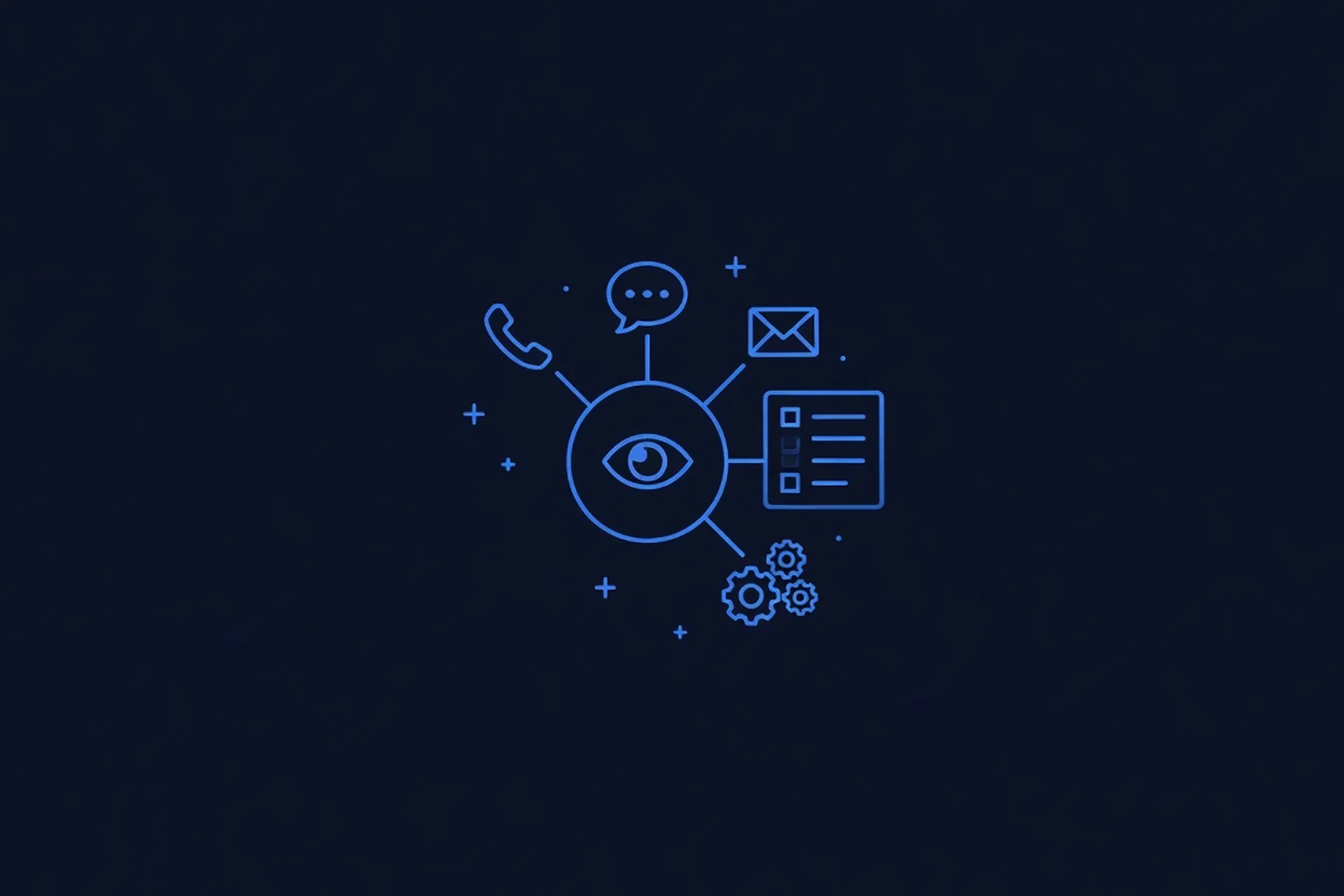
Under the hood, the architecture is a two-layer system the team calls Router and Workers. The Router is a continuously running coordination node that receives messages from multiple channels — group chats, email — and assigns tasks. Workers each keep their own context and run in parallel: one reproducing an issue, another reviewing code, another building a feature. You always talk to the same assistant, even while several agents work behind the scenes. DeepSeek says an internal version already runs as part of its day-to-day development, and its technical article argues that since a person can only track three to five active conversations at once, human attention — not model capability — is now the bottleneck. The team's own framing: as models and system architectures evolve together, "this more autonomous way of working could become the norm for human-AI collaboration."
From AI You Summon to AI That Is Already in the Room
Every AI tool a small business has bought so far — ChatGPT, a website chatbot, most "AI assistants" — shares one shape: you go to it. You open the app, you type the prompt, you wait. The entire value of the tool is gated behind your remembering to use it. That is exactly the limitation DeepSeek is attacking, and every major lab is now attacking with it. The direction of travel is AI that is present where work already happens — the inbox, the SMS thread, the missed call at 7:42 PM, the Facebook message from someone asking if you service Murrieta — and that acts on what it sees.
Notice what this actually is: the argument we have been making for AI employees since this blog started, arriving in the developer tools that preview what business tools become next. A front office that answers every call and message is not a chat box you open; it is a Router that never sleeps, watching every channel a customer might use, with workers behind it that book the appointment, send the confirmation text, and escalate to you only what genuinely needs a human. DeepSeek built that shape for bug fixes. The same shape answers your phones.
The Safeguards Are the Product
Here is the part most coverage will skip, and the part that matters most to a five-person business. DeepSeek's own documentation is unusually honest that an agent acting for a whole team can also waste the whole team's attention — so the prototype acts only when asked, or when a team's own rules explicitly allow it, and keeps a panel listing what needs a human. That is not a disclaimer; that is the design. An always-on agent without permission tiers and a visible approval queue is not an employee, it is a liability — the same lesson we drew when Grok's bot asked for run-of-your-phone permissions and when we sorted ChatGPT's iCloud plugins into credential tiers. The capability headline is never the question. The question is who approves what, and what you can see.
And run the standard trust checks on the vendor, too. This is a prototype — DeepSeek itself tells users to review and adapt the code before running it, and says the public version differs from the internal one. It is also a Chinese lab whose software US civilian federal agencies were told to remove from their devices just last month. None of that makes Super-Agent sinister; it makes it a reminder that "open-source" and "production-ready" are different words, and that the diligence questions we cataloged during Anthropic's IPO filing apply doubly to anything that reads your team's conversations.
Why This Matters for Your Business
Two takeaways survive the developer context. First, the bottleneck in your business is not AI capability — it is attention. You can track maybe three to five open customer conversations before one goes cold; your competitor's AI employee tracks all of them, forever. The gap between businesses that capture every inbound conversation and businesses that return calls "when things calm down" is about to become the most visible quality difference in local service industries. Second, the buying criteria are shifting. The question is no longer "how smart is the model" but "where does it sit, what does it see, who approves its actions, and can I audit what it did last Tuesday." Vendors who answer those four questions clearly — with permission tiers, action logs, and a human-approval queue — are built on the architecture the whole industry is converging on. Vendors who cannot answer them are selling last year's shape.
What a Temecula or Murrieta Business Should Do This Week
- Audit where your conversations actually happen. List every channel a customer can reach you on — phone, SMS, website chat, Instagram, Facebook, email, Google Business messages. That list is the deployment map for an always-on AI employee. Channels you never check are leads you already paid for and lost.
- Write your permission rules before any AI touches them. One page: what the AI may answer on its own (hours, pricing, service area, booking), what requires approval (quotes, discounts, complaints), and what it must escalate immediately. This is the Router-and-Workers discipline, sized for a storefront.
- Demand the approval queue and the log. Any AI employee you buy should show you, in one view, everything it did and everything waiting on you. If the demo does not include that panel, it is not built for a business; it is built for a hobbyist.
- Do not pilot frontier research prototypes on live customer conversations. Admire Super-Agent's architecture, then buy the production version of the pattern: an AI Chatbot at $397/mo for your site and messages, an AI Phone Agent at $697/mo answering every call, or the Full AI Package at $997/mo for the whole front office — trained on your business, free setup, month-to-month, cancel anytime. Book the free demo and ask us the four questions above; we like being audited.
The Bottom Line
DeepSeek gave away the blueprint for free: the next AI employee does not live in a tab you remember to open — it lives in the conversation, watching, and hands you a short queue instead of a long night. The labs will keep racing to make the workers smarter. Your job as a business owner is the part they cannot sell you: deciding what the AI may do alone, what it must ask about, and which conversations your customers are worth answering instantly. We build exactly that — the playbooks on this blog are the evidence.
Sources
- The Next Web — DeepSeek open-sources Super-Agent, a coding agent that reads team chats (November 1, 2026) — primary source for the release mechanics: code published on GitHub as dsh-superagent under an MIT licence; works on one GitHub repository and listens to Feishu, ByteDance's workplace chat app; opens tasks when an approved person asks, works in its own session, and replies in the original thread, for example with a pull request; a web panel lists what needs a human; DeepSeek calls it a research prototype that is "not an official DeepSeek product" and tells users to review and adapt the code before running it; the public code differs from the internal version; US civilian federal agencies were told to remove DeepSeek last month; the company has raised about $15 billion ahead of a planned listing, per Bloomberg.
- The Straits Times (Bloomberg) — DeepSeek drops enhanced coding agent with aim to rival Anthropic (November 1, 2026) — primary source for the positioning and the quotes: Super-agent is a prototype coding agent built to challenge Anthropic PBC's Claude Code; it can proactively monitor developer group chats and suggest solutions without being summoned, per the DeepSeek Harness team's WeChat post of October 31; the user manual on GitHub states the goal to "take as little human attention as possible, and give as much value as possible"; the Harness team was created earlier in 2026 to build agents competing with US labs' coding services; DeepSeek has raised about 100 billion yuan (about S$19.2 billion) in its latest round, one of China's largest ever, ahead of its IPO.
- Lianhe Zaobao — DeepSeek unveils architecture for one AI to coordinate multiple agents (November 1, 2026) — primary source for the architecture: Super-agent uses a two-layer Router/Worker design in which a continuously running Router receives messages from channels such as group chats and email and assigns tasks, while Workers keep independent contexts and run in parallel on issue reproduction, code review, and feature development; a person can typically track only three to five active conversations at once, making human attention the bottleneck; the design targets continuity, efficiency, proactivity, and persistence, including recovery from interruptions; an internal version already runs in DeepSeek's day-to-day R&D, and the team writes that this more autonomous way of working "could become the norm for human-AI collaboration."