AI Agents Aren't Buying From Your Website Yet — They're Deciding Who Humans Buy From
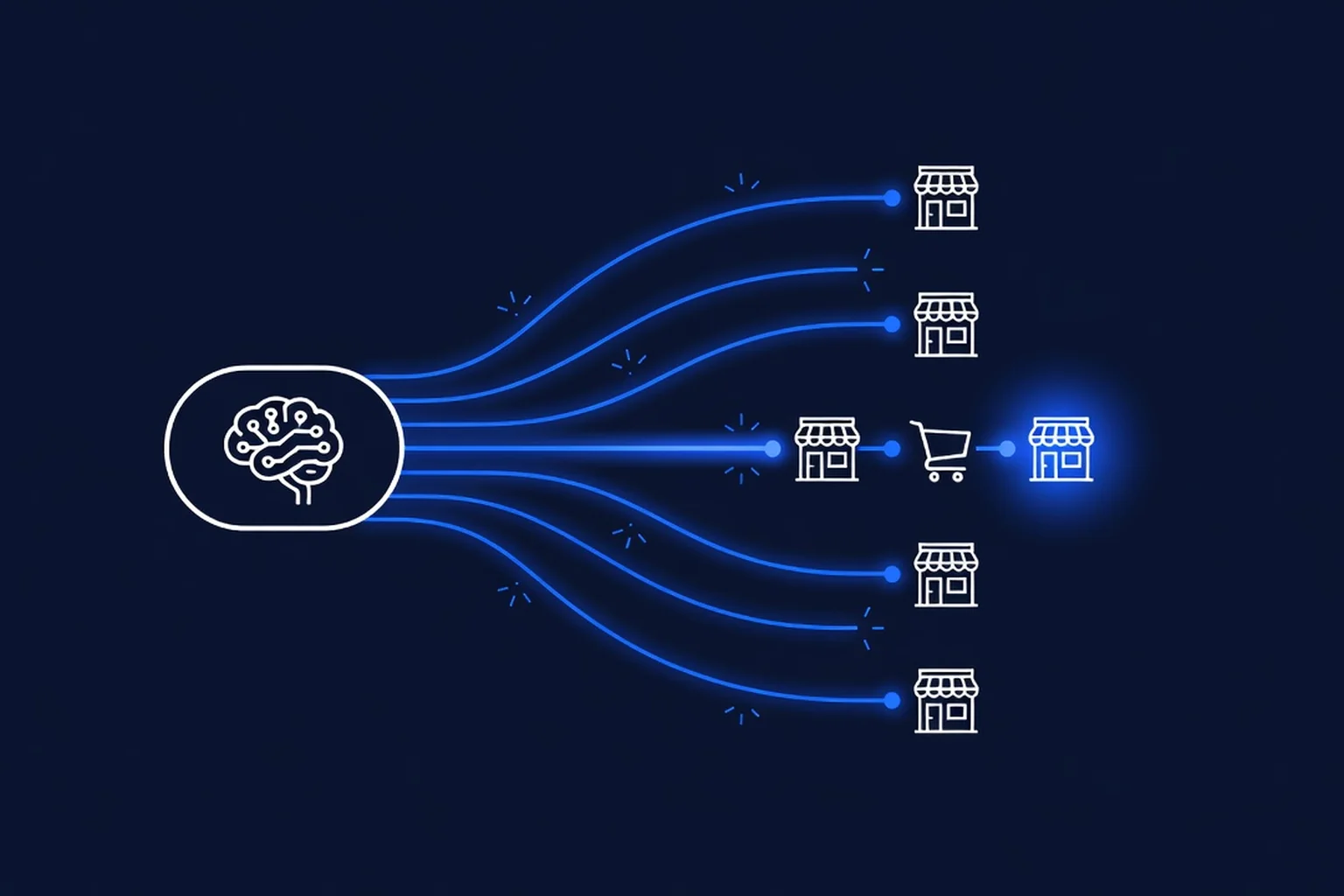
For a few months last fall, the future of online shopping looked like this: you would ask ChatGPT for running shoes, tap "Buy," and never leave the chat. OpenAI launched Instant Checkout on September 29, 2025 with Stripe, open-sourced the Agentic Commerce Protocol behind it, and promised a million-plus Shopify merchants were coming. Then, on March 4, 2026 — about five months in — OpenAI quietly pulled it back, rebuilt shopping around product discovery and retailer apps, and let checkout return to merchants' own websites.
If you run a small business and that sounds like a "nothing happened" story, you are reading the wrong numbers. While the checkout experiment stalled, the layer underneath it exploded: Adobe's latest AI traffic report shows AI-referred traffic to U.S. retail sites up 62 percent year over year in July 2026, and those visitors converted at a 60 percent higher rate than everyone else. AI agents are not buying from your website yet. They are deciding who the humans buy from — and that distinction is worth real money in 2026.
Here is what actually happened, what the payment networks are building next, and the short list of work that pays off for a small business while the giants sort out protocols.
What Actually Happened to "AI Will Buy For You"
The Instant Checkout retreat was not a rumor — OpenAI said it plainly at launch: ChatGPT would act "as the user's AI agent — securely passing information between user and merchant, just like a digital personal shopper would," with orders, payments, and fulfillment handled by the merchant's existing systems. The infrastructure was real. Stripe merchants could enable agentic payments "in as little as one line of code," and even non-Stripe merchants could join through the Shared Payment Token API.
The adoption never showed up. Despite Shopify enrolling a very large merchant base, reporting at the time indicated only around a dozen merchants ever went live with in-chat checkout. An OpenAI spokesperson framed the March pullback as a move rather than a retreat — "Instant Checkout is moving to Apps, where purchases can happen more seamlessly" — and the shopping experience was rebuilt around product discovery and retailer apps like Instacart, Target, and Expedia.
The lesson the industry took is not that agentic commerce failed. It is that the checkout layer was the weakest link and the discovery layer was the strong one. Merchants who spent 2025 preparing their product data, rather than integrating a checkout API, made the better bet. That bet is still paying.
The Numbers That Matter More Than the Checkout Drama
Two facts have to be held at the same time, and most coverage only reports one of them.
Fact one: the growth is extraordinary. Adobe Digital Insights — analyzing more than a trillion visits to U.S. retail sites — reported AI-referral traffic to retail up 62 percent year over year in July 2026, with travel up 119 percent. AI-referred retail visitors converted at a rate 60 percent higher than non-AI traffic (up from 54 percent in May), generated 53 percent more revenue per visit, spent 59 percent more time on site, and were 34 percent less likely to bounce. A year earlier, non-AI visits were still worth 128 percent more than AI visits; that gap has not just closed, it inverted.
Fact two: the base is still small. Early-2026 reporting had several large online retailers putting AI referrals under 2 percent of total traffic, with leaders nearer 5 percent. So this is a channel growing at double-digit-to-triple-digit monthly rates, converting better than anything else, and currently worth low single digits of your traffic.
That combination — small base, steep curve, high intent — is exactly the profile you want to prepare for before the Q4 shopping season, not after. And Adobe's survey explains where the intent comes from: 42 percent of consumers have now used AI assistants for online shopping, 66 percent visit a brand's website directly to verify an AI recommendation, and 89 percent click the links an AI assistant provides. When the AI mentions you, your website is where the decision gets confirmed.
Why Checkout Stalled — and Who Is Still Building It
The payment industry has not given up on agents completing purchases; it has industrialized the plumbing. Visa launched Intelligent Commerce Connect in April 2026 — a single integration that accepts payments initiated by every major agent protocol (the Agentic Commerce Protocol, Google's Universal Commerce Protocol, and others), works across token vaults, and, in Visa's own words, "makes merchant catalogs discoverable on AI platforms." Google's Universal Commerce Protocol is live in preview inside AI Mode and Gemini, built on Merchant Center feeds. Square shipped agentic commerce integrations with ChatGPT and Claude in July. Anthropic launched commerce-focused Claude agents the first week of September.
Notice the pattern: every serious 2026 build starts from the same foundation — the merchant's catalog and product data, structured so an AI can read it. The protocols are converging on "help the agent understand what you sell" before "let the agent pay for it." Which means the small-business work is the same regardless of which protocol wins.
What a Small Business Should Actually Do This Month
Adobe's report contains the least-hyped, most actionable finding of the year: across every industry it measured, blogs, guides, FAQs, and support pages scored highest for "AI citation readability" — the measure of how likely a page is to be parsed, understood, and cited by AI systems — while booking, checkout, and account-creation flows scored lowest. The content layer is where AI visibility is won. Five moves follow from that:
- Make your services and products machine-readable. Structured data (schema markup) on services, products, FAQs, and prices is what AI assistants cite. Our schema markup guide covers the tags that matter, and the AI search visibility guide shows how to check whether AI can currently parse you at all.
- Publish the questions customers actually ask. An FAQ page answering "how much does it cost," "how long does it take," and "do you serve my area" is not busywork — it is raw material for AI answers. This is the single highest-scoring page type Adobe measured.
- Keep the verification visit fast. Two-thirds of consumers check your website after an AI recommends you. A slow mobile page kills the confirmation. The boring fixes in our Core Web Vitals guide are the ones that matter.
- Fix your checkout, don't replace it. Your own checkout is where agentic traffic is being routed back to. Short forms, express payment buttons, and no surprises beat any protocol integration you could attempt today.
- Field the follow-up questions. AI-referred visitors arrive with high intent and specific questions. A chat widget that answers them at 11 p.m. converts the visit your new AI traffic already paid for — see the realistic setup in our AI chat widget guide.
The Local Angle: Temecula and Murrieta
This is not only an e-commerce story. Travel saw the fastest AI traffic growth of any industry in July — up 119 percent year over year, ahead of retail's 62 percent. Visitors planning a Temecula weekend are increasingly asking an assistant where to taste, eat, and stay — and the valley's $1.2 billion visitor economy flows to the businesses those answers name. A tasting room or restaurant with a readable website, a complete Google Business Profile, and a FAQ that actually answers "do you take reservations" is positioned for exactly the channel growing fastest. Google's own AI Mode has reached the scale where being visible inside it is a local-business question, not a tech question.
The Bottom Line
2026 settled the argument: agents recommend, humans confirm, and the merchant's website is where confirmation happens. The checkout protocols will keep evolving — Visa, Google, Stripe, and OpenAI are all still building, and one of them will eventually make agent payments routine. But the work that pays this quarter is older and simpler: be readable, be fast, answer real questions, and make your own checkout painless. The businesses doing that now will be the ones AI assistants name when the asking gets serious — and they will be ready when the buying follows.
PepeWebTech builds exactly this stack for small businesses here in Temecula and Murrieta: fast websites structured so AI search can cite them, chat agents that field questions after hours, and booking paths that convert AI-referred visitors. If you want your site ready before Q4 planning peaks, book a free 15-minute call or see the plans.
Sources
- OpenAI (Sep 29, 2025) — Instant Checkout launch: ChatGPT acting as the user's AI agent, Agentic Commerce Protocol open-sourced with Stripe, Etsy first with 1M+ Shopify merchants announced, merchants keep payments/fulfillment/customer relationships
- LearnWoo (Sep 2026) — Instant Checkout withdrawn Mar 4, 2026 after ~5 months; ~a dozen merchants went live despite Shopify enrollment; "moving to Apps" statement; checkout layer weakest, discovery layer strong; AI referrals under 2% of traffic at large retailers
- Adobe Digital Insights AI Traffic Trends Report (Aug 19, 2026) — July 2026: retail AI-referral traffic +62% YoY (travel +119%), AI retail conversion 60% higher, revenue per visit +53%, time on site +59%, bounce −34%; 42% of consumers used AI for online shopping; 66% verify on the brand's site; blogs/guides/FAQs highest AI citation readability, checkout flows lowest
- Visa (Apr 8, 2026) — Intelligent Commerce Connect: single integration accepting ACP/UCP and other agent protocols across networks and token vaults; makes merchant catalogs discoverable on AI platforms
- Digital Commerce 360 (Sep 3, 2026) — ReFiBuy AI Commerce Rankings: ChatGPT top referrer for 722 retailers (down from 844), Gemini doubled to 32, Perplexity +12, Claude rising; Square agentic integrations with ChatGPT/Claude; Anthropic commerce agents (Sep 2, 2026)