92% of Small Businesses Are Invisible to AI Search. Here's How to Fix It.
Affiliate Disclosure
Some links on this page may be affiliate links. If you click and make a purchase, PepeWebTech may earn a commission at no additional cost to you. We only recommend tools and services we genuinely believe in. See our full Affiliate Disclosure for details.
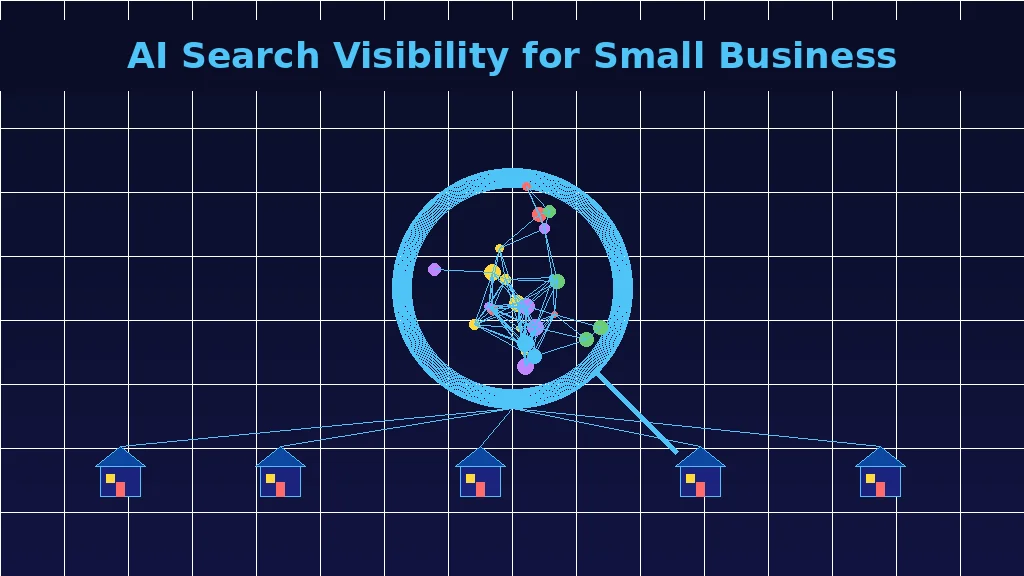
When someone asks ChatGPT "What's the best roofing company in Orange County?" or types "affordable dentist near Long Beach" into Perplexity, a single answer appears. One business gets the recommendation. The other 91% don't exist. A test by GetCatalyst found that 92% of local businesses do not show up in AI search answers at all. Here is what Southern California small business owners need to understand about AI search visibility, why traditional SEO is not enough anymore, and what you can do this week to start getting cited.
Category: SEO & Marketing 9 min readWhy AI Search Is Different From Google (And Why It Matters)
Traditional Google search shows you 10 blue links. You scroll, you click, you compare. AI search — whether it is ChatGPT, Perplexity, Google AI Overviews, or Brave's AI Summarizer — gives you one synthesized answer. Maybe two or three sources get cited. Everyone else is invisible.
This is not a future problem. BrightEdge data shows AI Overviews now appear in roughly 25% of Google searches, up from near zero a year ago. Perplexity reports serving over 250 million queries per month. ChatGPT Search launched in late 2024 and now handles a significant share of informational and local queries. The UK's Competition and Markets Authority just gave publishers the power to opt out of Google's AI summaries, reporting that media organizations have seen "a drop in click-through traffic to their websites — and therefore their revenue" since AI summaries started appearing at the top of search results.
If large media companies with dedicated SEO teams are losing traffic to AI summaries, imagine what happens to a local plumbing company in Anaheim or a boutique law firm in Irvine. You have no SEO team. You barely have time to update your Google Business Profile. And now a chunk of your potential customers are getting their answers from AI — answers that do not include your business.
The 92% stat is real. GetCatalyst ran a study in January 2026 showing that when AI search engines answer questions about local services, the vast majority of businesses in the area never appear in the response. The AI picks one or two businesses, cites them, and moves on. If your business is not the one picked, you do not exist in that search result.
How AI Search Engines Actually Pick Businesses
AI search engines do not use the same ranking algorithm as Google. They build answers by synthesizing information from web pages, reviews, business listings, and structured data. The businesses that get cited are the ones whose information is the most accessible, the most structured, and the most consistent across sources.
Here is what matters for AI citation, based on the research from Princeton's GEO (Generative Engine Optimization) paper and Andreessen Horowitz's analysis of the GEO framework:
- Structured data and schema markup. AI models parse JSON-LD and microdata far more reliably than they parse human-readable prose. If your website has proper LocalBusiness schema with your name, address, phone number, hours, services, and reviews marked up, AI search engines can extract that information directly. If your business details are buried in an image-heavy homepage with no structured markup, the AI skips you.
- Clear, factual content. AI models prefer concise, factual statements over marketing fluff. A page that says "We have been serving Orange County since 2008, specializing in residential roofing with a 4.9-star Google rating across 340 reviews" is far more likely to get cited than a page that says "Welcome to the premier roofing experience in Southern California, where quality meets excellence."
- Third-party citations. When your business appears in local directories, news articles, blog posts, and review sites, AI search engines cross-reference those mentions to validate your information. A business that appears on Yelp, Google Business Profile, the local Chamber of Commerce directory, and two local news articles is more credible to an AI model than a business that only exists on its own website.
- FAQ and Q&A content. AI search engines are essentially question-answering machines. Pages that directly answer common questions — "How much does a roof replacement cost in Orange County?" or "Do you offer free consultations?" — are prime citation material because they map directly to the queries users type into AI search.
- Reviews with specific details. A review that says "Great company, highly recommended" is nearly useless for AI citation. A review that says "ABC Roofing replaced our 1,800 sq ft tile roof in two days for $12,000, crew was professional, cleanup was perfect" contains structured information the AI can use to answer specific questions.
The New Tools: Checking Your AI Search Visibility
You cannot fix what you cannot measure. Until recently, there was no way to check whether your business appeared in AI search answers. That changed in 2026 with a wave of new tools built specifically for AI search visibility.
AgentScore (agentscore.com) launched in July 2026 as a tool that checks how your business appears across AI search engines. Think of it as Lighthouse for AI agents — it scores your visibility across ChatGPT, Perplexity, Google AI Overviews, and other AI answer engines, and tells you exactly what is missing. A Hacker News post from July 8 called it "a tool that checks how your business appears in AI search."
Bloomiro (bloomiro.com) launched on July 7, 2026, as an MCP (Model Context Protocol) tool that helps improve both traditional SEO and AI search visibility. It scans your site and identifies content and structural changes that would make your business more likely to get cited by AI models. The tool scored 5 points on Hacker News within a day of launch, signaling developer and marketer interest.
Sitefire, a Y Combinator Winter 2026 batch company, launched in March to "automate actions to improve AI visibility." It scored 36 points on Hacker News and has since been building tools that go beyond analysis into active optimization — automatically adjusting structured data, updating directory listings, and suggesting content changes to improve AI citation rates.
LLMGeoKit (llmgeokit.com) offers a free scanner for AI and LLM visibility, calling itself "the new SEO." It checks whether your business information is accessible to large language models and flags gaps in your structured data or content that would prevent AI citation.
BenchLocal (github.com/stevibe/BenchLocal), launched July 6, 2026, is an open-source AI-powered local business search tool. While designed for research rather than optimization, it shows how AI models interpret and rank local business information — useful for understanding what the AI "sees" when it evaluates your business.
These tools are new, and most are free or have free tiers. If you own a small business in Southern California, run your website and business name through at least two of them this week. The baseline audit takes under ten minutes and will show you exactly where you stand. And if you're producing the content and structured data that earns those AI citations, Z.AI's GLM Coding Plan offers an affordable $18/month API for generating schema-ready content and FAQ drafts at scale.
The UK Just Let Publishers Opt Out of AI Search. What That Means for You
On June 3, 2026, the UK's Competition and Markets Authority announced that publishers and website owners can now block their content from appearing in Google's AI summaries. Google confirmed it would test the new controls with UK publishers before rolling them out globally.
This is important for small businesses for two reasons. First, it confirms that AI search is now a major traffic source — large enough that media companies demanded (and got) the right to control how their content is used. Second, the opt-out mechanism means that businesses can choose whether to participate in AI search at all.
For most small businesses, the answer should be "yes, absolutely participate." Unlike large publishers who worry about AI summaries cannibalizing their article traffic, your business benefits from AI citations. When ChatGPT recommends your roofing company, that is a lead you would not have gotten otherwise. Opting out of AI search would be like telling Google "do not show my business in search results" — self-defeating.
The exception: if your business data is inaccurate in AI answers, you may want to investigate correction mechanisms before participating. AI models can sometimes pull outdated or incorrect information from old listings. The tools above help you catch that.
Actionable Steps to Improve Your AI Search Visibility This Week
You do not need a $5,000 SEO retainer to start showing up in AI search. Here is what you can do in the next seven days:
- Add LocalBusiness schema markup to your website. If your website does not have JSON-LD structured data for your business, add it. Schema.org provides the standard LocalBusiness markup format. It should include your business name, address, phone number, URL, hours of operation, price range, service area, and a description of your services. Your web developer can do this in under an hour. If you are on WordPress, plugins like Schema Pro or Rank Math can generate it automatically from your business profile. We covered schema markup for AI search in a previous post — the principles are the same here.
- Rewrite your homepage and service pages for clarity. Audit your top pages and replace vague marketing language with specific, factual statements. Include your service area ("serving Orange, Los Angeles, and Riverside counties"), your years in business, your Google rating and review count, and a concise list of services with pricing where possible. AI models reward specificity.
- Add an FAQ section to your website. Create a page that answers the five to ten questions your customers ask most often. Include questions like "How much does [service] cost?" "What areas do you serve?" "Do you offer free estimates?" "What are your hours?" These map directly to AI search queries and become prime citation material.
- Update your Google Business Profile completely. Fill every field. Add photos, services, service areas, attributes, and a detailed business description. GBP data feeds directly into Google AI Overviews and Gemini responses. An incomplete profile is an invitation for the AI to skip you in favor of a competitor with better data.
- Check your directory consistency. Your NAP (Name, Address, Phone) should be identical across Google Business Profile, Yelp, Bing Places, Apple Business Connect, Facebook, and your own website. Inconsistencies — like "123 Main St" vs. "123 Main Street" or an old phone number on Yelp — confuse AI models and reduce citation confidence. Use a tool like BrightLocal or Whitespark to audit and fix these listings.
- Run your first AI visibility audit. Go to AgentScore or LLMGeoKit and enter your business name and website. Review the results. If your score is low, the tool will tell you what to fix. If your score is high, you are ahead of most of your competitors — the 92% who are invisible.
- Ask customers for specific reviews. When you ask for a review (and you should ask after every positive interaction), guide customers toward specifics: "Please mention what service you used and your experience." A review that says "Had a great experience with the kitchen remodel — $45k total, finished in 3 weeks, crew was clean and professional" is gold for AI citation.
GEO vs. SEO: What Actually Changes
The term "Generative Engine Optimization" (GEO) was coined in a 2024 paper by Princeton researchers and popularized by a16z's analysis. It describes the practice of optimizing content for AI-generated search answers rather than traditional link-based rankings. The core idea: instead of optimizing for position #1 on a list of ten links, optimize for being cited in the single AI-generated answer.
The practical overlap with traditional SEO is significant. Schema markup, quality content, fast loading, mobile-friendly design, and strong reviews all help with both traditional and AI search. The differences matter at the margins:
- Traditional SEO rewards backlinks heavily. AI search rewards structured data and content clarity more than raw link authority.
- Traditional SEO optimizes for click-through rate from search results. AI search optimization aims for citation — getting mentioned in the answer, period.
- Traditional SEO focuses on keywords and meta tags. AI search optimization focuses on entity information — who you are, where you are, what you do, and what customers say about you.
- Traditional SEO treats Google as the only search engine. AI search optimization requires thinking about ChatGPT, Perplexity, Gemini, Brave, Claude, and any other model that generates answers from web data.
You do not need to abandon traditional SEO. It still drives traffic. But if you are only doing traditional SEO and ignoring AI search visibility, you are leaving leads on the table — especially in local service industries where AI answers directly influence buying decisions.
What This Means for Your Southern California Business
Southern California is one of the most competitive local markets in the country. A dentist in Laguna Hills is competing with hundreds of other dentists for the same AI recommendation. A roofing company in Riverside is fighting for attention alongside every other contractor in the Inland Empire. The businesses that show up in AI answers will capture a growing share of those leads as more consumers shift from scrolling search results to asking AI questions.
The tools to check and improve your AI visibility are free or cheap. The optimizations — schema markup, clear content, complete business profiles, FAQ sections — are things your web developer can implement in a few hours. The reviews and directory consistency are things you can manage yourself. There is no reason to stay in the 92% that AI search ignores.
The first step is simple: find out where you stand. Run an AI visibility audit today. If your business is invisible, you now know why — and you know exactly what to fix.
Need Help Getting Your Business into AI Search?
If you own a small business in Southern California and want to improve your AI search visibility, we can help. We specialize in building websites and optimizing online presence for local businesses in Orange County, Los Angeles, San Diego, and the Inland Empire. We handle the schema markup, content optimization, and directory management so you can focus on running your business. Get in touch for a free consultation.
Sources
- GetCatalyst — "92% of local businesses don't show up in AI answers" (January 2026)
- Andreessen Horowitz — "How Generative Engine Optimization (GEO) Rewrites the Rules of Search" (May 2025)
- The Guardian — UK media groups given power to block Google using their articles in AI search (June 3, 2026)
- AgentScore — AI search visibility auditing tool (July 2026)
- Bloomiro — MCP tool for SEO and AI search visibility (July 2026)
- LLMGeoKit — Free scanner for AI/LLM visibility (January 2026)
- BenchLocal — AI-powered local business search tool (July 2026)