Q4 2026 Is Projected to Cross $1 Trillion. Your Small Business Has 10 Weeks to Get Ready.
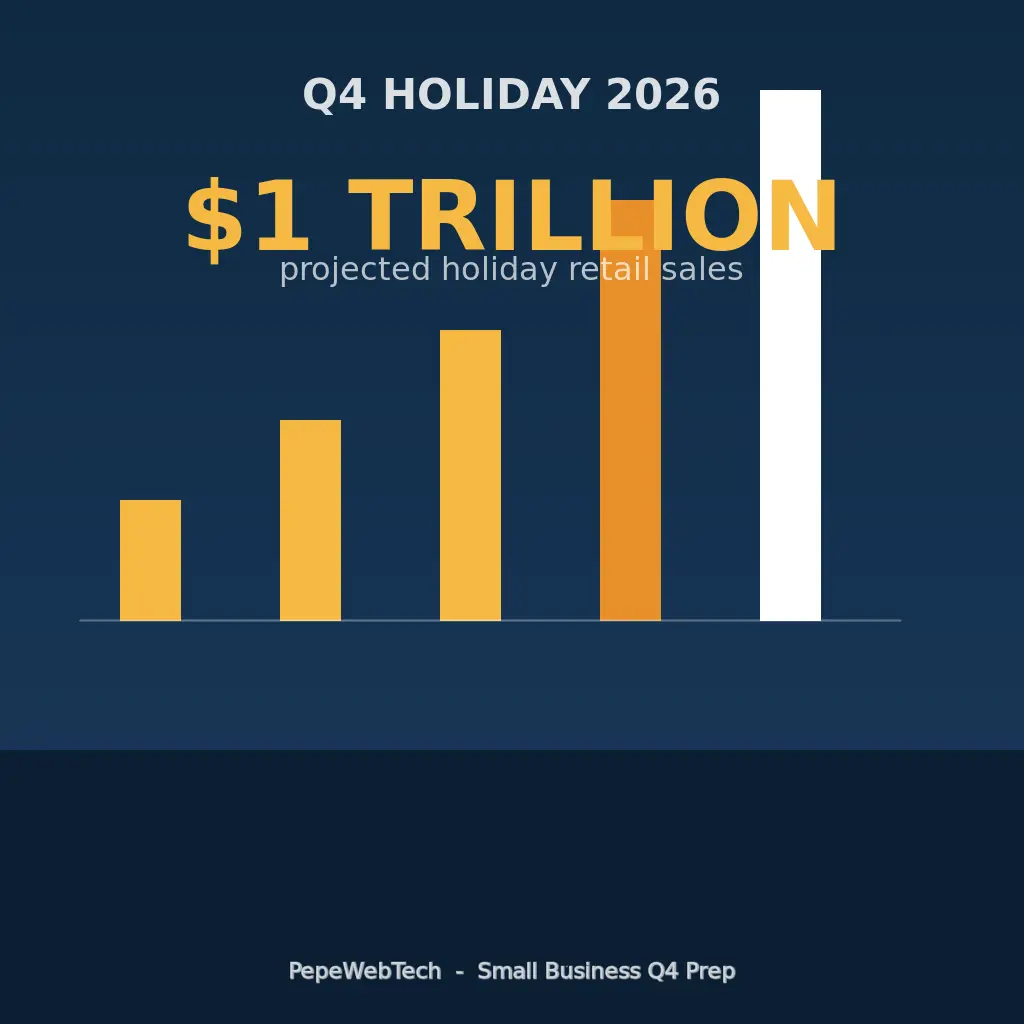
The National Retail Federation forecasts November and December 2026 retail sales between $1.01 trillion and $1.02 trillion — a 2.5% to 3.0% increase over last year's record. That is the first time holiday spending is expected to cross the trillion-dollar mark. Meanwhile, the average small business does not start its holiday prep until mid-October. By then, the shipping deadlines, inventory windows, and ad rates have already moved against you. This is the plan for what to do in August, September, and October so your Southern California business is actually ready when the money starts moving in November.
Category: Business Growth 9 min readWhy a Trillion-Dollar Holiday Matters to a Five-Person Shop
You do not need to be Target to benefit from a record holiday season. The NRF numbers cover total retail, but the growth is not evenly distributed. Online and mobile commerce continue growing two to three times faster than physical retail, and local service businesses — the plumber, the salon, the caterer, the auto shop — see their own Q4 spike driven by holiday budgets, year-end home repairs, and event season in Southern California.
Here is what actually happens when a small business waits too long:
- Inventory ordered in October arrives in late November, because every other business ordered at the same time and freight capacity tightens. Ocean freight peak booking season runs through September.
- Ad costs spike 30% to 50% from mid-October through Cyber Monday, because that is when everyone starts bidding. CPCs you planned around in August no longer apply.
- Website crashes during peak traffic because nobody load-tested the checkout. A store doing 50 orders a day suddenly does 300 on Black Friday and the cart breaks.
- Customer service drowns because nobody staffed or automated for triple the volume, and unanswered questions become abandoned carts.
Every one of those failures has a fix that costs less than the revenue it protects. But the fixes take weeks to implement, which is why August is when you start — not November.
The Money on the Table
Let's put real numbers on it. A typical Southern California service business or small retailer doing $30,000 a month in Q1 through Q3 can reasonably expect a 20% to 40% revenue lift in November and December combined. That is an extra $12,000 to $24,000 across two months — money that funds January inventory, end-of-year bonuses, or the tax bill.
But the lift only materializes if three things are true: your customers can find you, your site can handle the traffic, and you can actually fulfill orders or book jobs without dropping them. Miss any one of those and the projected lift becomes a projected loss, because you spent on ads and inventory but could not convert.
The businesses that win Q4 are not the ones with the biggest budgets. They are the ones who locked in their inventory by mid-September, load-tested their site in October, and had their customer service coverage sorted before the first holiday ad ran.
The 10-Week Prep Timeline
This is the timeline logistics and ecommerce operators use. It works for any business with a website and a Q4 revenue spike.
August (Weeks 1-4): Forecast and Order
Right now, your job is forecasting and ordering. Pull your 2025 Q4 sales data by product or service category. Identify your top 20% of sellers — those are what you need to keep in stock or have capacity for. Identify anything that went out of stock last year and cost you sales. Place inventory orders now, especially anything imported, because ocean freight capacity tightens through September and carrier cutoffs for guaranteed holiday delivery start closing in early December.
If you sell services, this is when you map your calendar. How many jobs can your team realistically take in November and December? Block the dates now, build in buffer for weather and sick days, and set a hard cutoff for new bookings so you do not overpromise.
September (Weeks 5-8): Load Test and Automate
September is infrastructure month. Three things must happen here.
First, load test your website. Simulate peak traffic volumes on your checkout and find the breaking points before Black Friday does. If your live chat or cart crashes under load in September, you will be grateful you found out now instead of on Cyber Monday. Tools like k6 (free), Loader.io (free tier), or your hosting provider's built-in load testing can simulate a traffic spike in an afternoon. If your site is on shared hosting or a basic Shopify plan, ask your developer whether you need to upgrade your plan tier before November.
Second, automate your customer service baseline. Holiday volume triples the number of questions about shipping, returns, hours, and stock. An AI chat widget on your site can answer 60% to 80% of those instantly — hours, location, return policy, order status, FAQ — leaving your human staff to handle the complex cases. This is not about replacing people. It is about not losing the sale because a customer asked "do you have this in stock" at 9 PM and nobody answered until morning. AI chat widgets start around $39 to $49 per month.
Third, finalize your ad creative and audiences now. Build your Black Friday and holiday ad campaigns in September so they are approved and ready to launch. Wait until November and you are fighting for ad inventory at peak prices, and your creative is rushed.
October (Weeks 9-10): Final Checks and Go-Live
Two weeks out, confirm your shipping cutoff dates with carriers and post them clearly on your site. Update your return policy for holiday extensions. Test your abandoned-cart email sequence. Confirm your payment processor can handle the volume — some smaller processors hold funds or flag spikes as fraud, which freezes your cash flow exactly when you need it. Make sure your SSL certificate is current and your site is running HTTPS everywhere; browsers flag expired certs and shoppers abandon.
The Website Checklist (Do This This Week)
Most small business websites have the same five Q4 vulnerabilities. Run through these now.
- Test your checkout on a phone. Over 60% of holiday shopping traffic is mobile. If your checkout requires zooming, pinching, or more than three taps to complete, you are losing sales. Fix the friction now.
- Check your page load speed. Google's Core Web Vitals now require Largest Contentful Paint under 2.0 seconds. A slow site on Cyber Monday does not just rank worse — it loses the customer who clicked and waited. Run a free test at PageSpeed Insights and fix anything flagged red.
- Update your shipping and return policy pages. Holiday shoppers check these before buying. Post your guaranteed holiday delivery cutoff dates clearly. A clear, generous holiday return policy increases conversion; a vague or missing one kills it.
- Add a stock urgency signal. If you use Shopify, WooCommerce, or BigCommerce, enable low-stock alerts on product pages. "Only 3 left" converts. It also has to be accurate — do not fake it.
- Set up abandoned cart recovery. If you have not already, enable the built-in abandoned cart emails in your platform. A simple three-email sequence (reminder, discount, final notice) recovers 10% to 15% of lost carts. This is the single highest-ROI email setup for Q4.
What About Service Businesses?
If you do not sell products online, Q4 still matters — differently. Southern California service businesses see a distinct Q4 pattern driven by holiday event season, year-end home improvement, and tax-year spending.
For service businesses, the prep is about capacity and capture. Capacity: map your team's availability now and set booking cutoffs. Capture: make sure every inquiry — phone, web form, DM — gets a response fast. The data is consistent: 85% of missed callers never call back, and the average small business misses over 60% of incoming calls. During Q4, when call volume spikes, that gap widens. An AI phone agent that answers every call, books appointments, and captures lead details 24/7 runs $697 per month through an agency like ours — far less than the jobs it captures.
If you run a salon, catering company, HVAC shop, or any business where Q4 bookings cluster, the question is not whether you will get the calls. It is whether you will answer them.
The One Mistake That Costs the Most
Across every Q4 failure mode, one mistake shows up more than any other: treating holiday prep as a November project. By November, shipping windows have closed, ad rates have peaked, and your site is either ready or it is not. There is no time to fix anything.
The businesses that consistently outperform in Q4 are the ones who treat August as the start of holiday season. They order inventory in August and September. They load-test in September. They finalize creative in October. By the time November arrives, they are executing a plan, not building one under pressure.
If you read this and realize you have not started, that is fine — you are reading this in August, which is exactly when you should start. You have ten weeks. That is enough time if you move now.
What to Do This Week
- Pull your 2025 Q4 sales data and identify your top sellers and stockouts
- Place inventory orders for anything imported or long-lead-time
- Load test your website checkout — simulate triple your normal traffic
- Test your site on a phone and fix any checkout friction
- Map your team's Q4 capacity and set booking cutoffs for service businesses
- Draft your holiday ad creative so it is ready to launch, not rushed in November
If your website is not ready for a traffic spike, your checkout has friction, or you want an AI chat or phone agent handling holiday inquiries, contact PepeWebTech. We build, fix, and maintain websites and AI tools for Southern California small businesses — and Q4 readiness audits are what we do every August.
Sources
- National Retail Federation — Winter Holidays Data and Trends (2025 holiday sales forecast of $1.01 to $1.02 trillion, 2.5% to 3.0% growth)
- KOB / Associated Press — NRF forecasts holiday sales to increase 2.5% to 3.0%, first trillion-dollar season
- Digital Applied — Q4 2026 Ecommerce Peak Season Prep: The Full Playbook (timeline and load-testing guidance)
- 3PL Guys — How to Prepare Your Fulfillment Strategy for Q4 Peak Season (September load testing and inventory deadlines)
- Ringly.io — Ecommerce Customer Service Peak Season: The Complete Guide (month-by-month preparation timeline)
- GoFreight — 2026 Peak Season Logistics Calendar (ocean freight peak booking period September)