StackOverflow Just Lost Half Its Traffic to AI. Your Small Business Website Is Next.
Affiliate Disclosure
Some links on this page may be affiliate links. If you click and make a purchase, PepeWebTech may earn a commission at no additional cost to you. We only recommend tools and services we genuinely believe in. See our full Affiliate Disclosure for details.
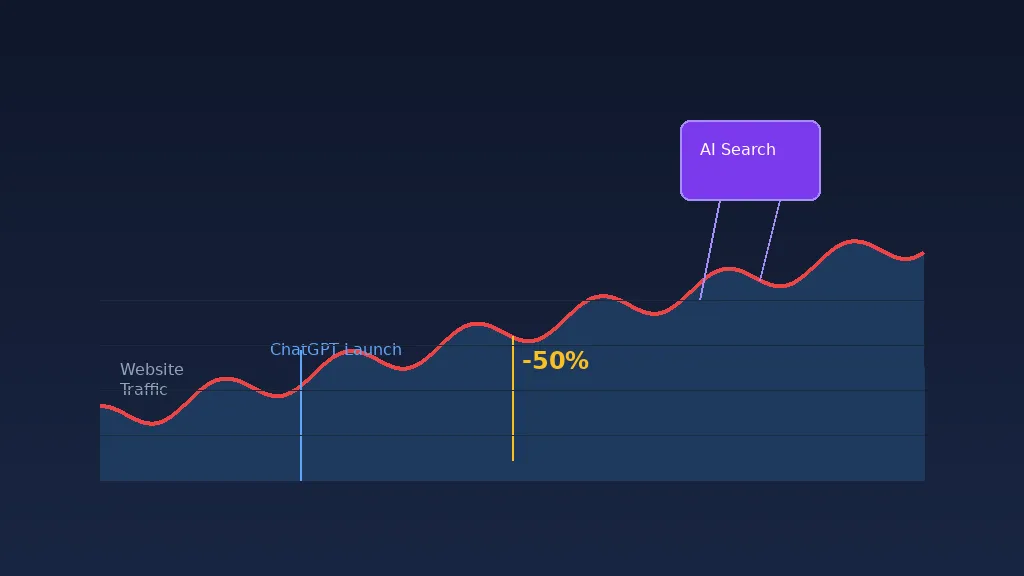
A chart went viral on Hacker News today showing what happened to StackOverflow's traffic after ChatGPT launched: it fell off a cliff. Monthly questions are down roughly 50% from peak. The same shift is happening to small business websites across Southern California — you just can't see it yet. Here's what the data shows and what your business should do about it.
Category: SEO & Marketing 9 min readThe Chart That Should Scare Every Small Business Owner
Today a post titled "What AI did to StackOverflow in a graph" hit the front page of Hacker News with over 230 upvotes. The data, pulled directly from Stack Exchange's public query tool, shows monthly questions on StackOverflow dropping by roughly half since late 2022 — right when ChatGPT launched.
This isn't speculation. It's a SQL query against StackOverflow's own database, run on their own data explorer tool. The decline is steep, sustained, and shows no signs of reversing.
Why did this happen? Developers stopped searching Google for coding answers and started asking ChatGPT, Claude, and GitHub Copilot instead. The question got answered inside the AI tool. No click through to StackOverflow. No pageview. No ad impression. No new user registration.
Here's why this matters to you even if you've never posted on StackOverflow in your life: the same dynamic is now hitting every small business website that relies on organic search traffic.
How AI Search Works Against Your Website
When someone searches Google for "best plumber in Riverside CA" or "how much does a kitchen remodel cost in Orange County," the old behavior was: click a result, visit a website, read the page, maybe call the business. Each click was a potential customer entering your funnel.
Now Google's AI Overviews — those AI-generated answer boxes at the top of search results — answer many of these questions directly. The user reads the AI summary, gets what they need, and never clicks through to your site. Similarweb data shows AI Overviews now appear on roughly 25-30% of Google searches, and industry studies report that when an AI Overview appears, organic click-through rates drop by 25-50%.
And it's not just Google. Perplexity, ChatGPT with web search, and Bing Copilot are all doing the same thing: answering questions by reading your website content and presenting the answer without sending the user to you. Your content does the work. Someone else gets the traffic.
SparkToro's research from 2024 found that nearly 60% of web searches in the U.S. already ended without a click to any website. Rand Fishkin, SparkToro's founder, called this the "zero-click search" problem. AI is accelerating that trend dramatically.
The Numbers You're Probably Not Tracking
Most small business owners check their website analytics once a month, if that. They look at total visits, maybe bounce rate. But the meaningful number is organic search sessions from non-branded queries — the people who found you by searching for a service you offer, not by typing your business name.
Here's what's happening industry-wide in 2026:
- AI Overviews zero-click rate: Studies across SEO platforms show that when Google displays an AI Overview, 25-50% of users get their answer and leave without clicking any result. This is according to data from Semrush, Ahrefs, and BrightEdge tracking.
- Perplexity and ChatGPT traffic siphoning: Perplexity reported over 100 million monthly active users in early 2026, and ChatGPT's web search feature handles hundreds of millions of queries. These searches never produce a Google click at all.
- Declining "long-tail" organic traffic: The specific informational queries — "how much does X cost," "what's the best Y near me," "do I need a permit for Z" — are the ones AI answers most confidently. These used to be the bread and butter of small business SEO traffic.
The StackOverflow chart is a leading indicator. Developers were early AI adopters, so the shift showed up there first. Small business search queries are next in line — and in many categories, the decline is already underway.
This Is Not a Temporary Fluctuation
Every few months, Google rolls out a core algorithm update and some business owners see their traffic bounce back. They think the AI threat was overblown. It wasn't.
The structural shift is this: Google is now in the business of answering questions, not just linking to answers. They've said as much. Google CEO Sundar Pichai called the shift to AI Overviews "the biggest quality improvement in Search history." That's not a company planning to go back to ten blue links.
We've covered several of these shifts on this blog: Google's May 2026 core update directly affected AI Overview rankings, Google Search Console now reports AI Overview impressions, and the EU antitrust ruling against Google's search monopoly may change how results are displayed. The direction is clear — AI-generated answers are becoming the default, not the exception.
For small business websites, this means the traffic model that worked from 2010 to 2023 — write content, rank on Google, get visitors — is permanently changing. You can still get traffic from search, but the volume will be lower and the competition for actual clicks will be fiercer.
What Your Small Business Should Do Right Now
The businesses that survive this shift won't be the ones that write more blog posts. They'll be the ones that adapt their web strategy to a world where AI answers come first and clicks come second. Here's how to do that.
1. Optimize for AI Citations, Not Just Rankings
When ChatGPT or Perplexity cites your business as a source, it's doing free marketing on your behalf. But to get cited, AI systems need structured, authoritative content. This is what the industry calls GEO — Generative Engine Optimization — and we've covered the basics in a previous post.
The short version: add structured data (schema markup) to your website. Make your NAP (name, address, phone) consistent everywhere online. Write content that directly answers common customer questions in clear, factual language. AI models prefer structured, authoritative sources — the kind of content that makes your business look like the definitive answer.
2. Own Your Brand Search
AI Overviews are weakest on branded queries. When someone searches "Riverside CA landscaping company," AI might give generic advice. But when someone searches "[Your Business Name] reviews" or "[Your Business Name] pricing," the results are about you specifically. The click-through rate on branded searches remains high because users are looking for your specific business.
Invest in building your brand name recognition in your local market. That means Google Business Profile optimization, consistent review collection, local directory listings, and community presence. When people search for your business by name, AI can't replace the click.
3. Build Direct Traffic Channels
If Google organic traffic is declining, you need other ways to get people to your website:
- Google Business Profile. An optimized profile with consistent reviews drives direct profile visits and phone calls that bypass the organic search decline entirely. GBP signals also feed directly into local AI search results.
- Email lists. A 500-person email list that you email weekly with useful content will outperform a 1,000-visitor-per-month organic search strategy in 2026 because you control the delivery.
- Social media with purpose. Instagram Reels for visual businesses. LinkedIn for B2B. The key is always a call to action: "link in bio" or "visit our website for a free estimate."
- Digital referrals. Google reviews, Nextdoor recommendations, Yelp check-ins — the online version of word of mouth. Make it easy for satisfied customers to leave reviews.
4. Make Every Page That Does Get Visited Count
Each visit is more valuable when fewer people are clicking through. Every page should have a clear next step: a phone number, a contact form, a booking button, an email capture. Common gaps we see: no phone number above the fold on mobile, buried contact forms, no booking system, no AI chatbot. These aren't nice-to-haves — they're conversion essentials. If your team needs help producing the deeper, original content that AI can't replace, Jasper is one of several AI writing assistants built for marketing teams — but it works best paired with human editing, not as a substitute for it.
5. Track the Right Metrics
Stop obsessing over total pageviews. The metrics that actually matter in the AI search era:
- Organic non-branded sessions: Traffic from searches about your services (not your business name). This is the number most affected by AI Overviews.
- AI Overview impressions: Google Search Console now reports these. Track whether your content is being cited in AI answers, even when it doesn't generate clicks.
- Conversion rate: Of the people who do visit your site, what percentage take action (call, book, email)? If traffic drops 20% but conversion rate goes from 2% to 5%, you're actually getting more customers from fewer visitors.
- Direct and branded traffic: Track these separately. They should be growing as your brand recognition improves, even if organic non-branded traffic declines.
The Businesses That Will Win in the AI Search Era
StackOverflow's highest-quality content still attracts traffic — the deeply technical answers that AI can't reliably reproduce. The generic questions that AI can answer in one paragraph are the ones that disappeared.
Apply the same logic to your website. If your content is generic — "What is SEO?" "How to choose a contractor" — AI answers those and your pages collect dust. But if you publish content only you can write — local pricing guides, case studies from your area, customer stories from Riverside or Orange County — that's harder for AI to replace and more likely to get cited.
The winning businesses stop treating their website as an SEO play and start treating it as their digital headquarters. The place where someone who already knows your name goes to verify, book, and buy. Search traffic becomes one channel among many, not the only one.
The Bottom Line
StackOverflow lost roughly half its traffic because AI started answering the questions it used to host. The same pattern is coming for every small business website that depends on organic search for customer acquisition. It's not a future threat — it's happening now.
You can't stop AI from answering questions. What you can do is make sure your business shows up in AI answers, own your brand search so customers find you directly, build traffic channels you control, and make every website visit count with clear calls to action.
The transition from search-traffic-dependent to multi-channel is not optional. The businesses that make it early will have a head start on the ones that only notice when their traffic graph starts looking like StackOverflow's. For producing the original, locally-specific content that AI can't replace, Z.AI's GLM Coding Plan provides a cost-effective $18/month API for drafting blog posts, case studies, and FAQ content — a practical tool for small teams that need to publish more without ballooning their AI spend.
Need help adapting your Southern California small business website for the AI search era? Get in touch with PepeWebTech. We build websites and AI integrations that work in the post-Google-ten-blue-links world.
Sources
- Hacker News — "What AI did to stackoverflow in a graph" (July 18, 2026)
- Stack Exchange Data Explorer — AI Impact on StackOverflow Traffic Query
- Stack Exchange Data Explorer — Total Monthly Number of StackOverflow Questions Over Time (1,550 upvotes, Jan 2026)
- SparkToro/Rand Fishkin — Zero-Click Search Results Study
- Google Blog — AI Overviews in Search