AI Agent Workflows: The Future of Business Automation

The single-tool era is ending: ChatGPT alone isn't enough anymore. Smart businesses are connecting multiple AI agents into workflows that handle complex tasks from start to finish—without human intervention.
AI agent workflows are the next evolution in business automation. Here's how small businesses can build these systems without a team of developers.
The Shift
From "Use ChatGPT for this" to "Let AI agents handle this entire process end-to-end"
What Are AI Agent Workflows?
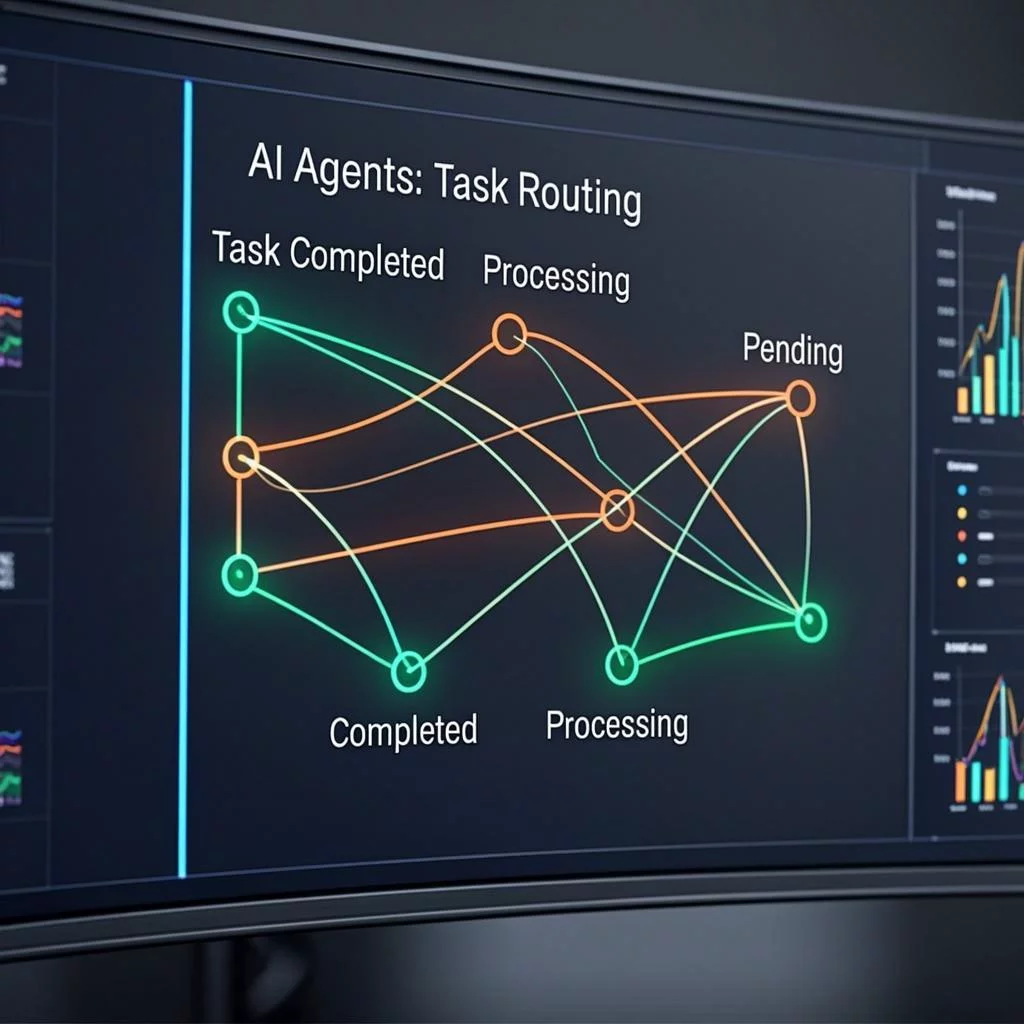
An AI agent workflow is a coordinated system of multiple AI agents, each with a specific role, working together to complete complex tasks. Think of it like a virtual team.
Each agent has one job and does it well. Together, they automate processes that previously required multiple human specialists.
Why This Matters Now
1. Beyond One-Off Tasks
Single AI tools are great for one thing—writing an email, generating an image, summarizing a document. But businesses run on processes, not isolated tasks.
data analytics The Opportunity
AI agent workflows close the gap. They connect tools, share data, and complete entire workflows automatically.
2. No-Code Accessibility
You no longer need developers to build these systems. Platforms like OpenAI's Assistants API, LangChain, and no-code workflow builders make agent orchestration accessible to non-technical teams.
Real example: A small e-commerce business set up an agent workflow that processes customer returns in under 5 minutes—previously a 2-hour manual process involving 3 employees.
3. Competitive Advantage
Businesses that adopt agent workflows now are seeing:
- 60-80% reduction in repetitive task time
- 90% fewer errors in multi-step processes
- 24/7 operation without human staffing
Real-World Workflow Examples
Example 1: Content Marketing Workflow
Goal: Research, write, edit, and publish a weekly blog post
Agents involved:
- Research Agent: Scans news sources, identifies trending topics, gathers data
- Writer Agent: Drafts the article based on research
- Editor Agent: Reviews for grammar, clarity, SEO optimization
- Publisher Agent: Uploads to CMS, formats, schedules social media
Result: 1 blog post per week, zero human time spent (after initial setup)
Example 2: Customer Support Workflow
Goal: Handle common customer inquiries end-to-end
Agents involved:
- Triage Agent: Classifies incoming support tickets by urgency and category
- Knowledge Agent: Searches documentation for relevant answers
- Response Agent: Drafts personalized responses
- Escalation Agent: Flags complex issues for human review
Result: 70% of tickets resolved automatically, 24/7 coverage
Example 3: Sales Lead Qualification Workflow
Goal: Qualify and route incoming leads automatically
Agents involved:
- Enrichment Agent: Gathers company data, tech stack, size
- Scoring Agent: Evaluates lead fit against ideal customer profile
- Routing Agent: Assigns to appropriate sales rep or automated nurturing
- Outreach Agent: Sends personalized follow-up sequences
Result: 3x faster lead response time, 40% higher conversion rate
How to Build Your First Workflow
Step 1: Pick One Process
Don't try to automate everything. Start with:
- A process that's well-defined (clear steps, clear outcome)
- A process that's repetitive (happens regularly)
- A process that's low-risk (mistakes won't cause major problems)
Good first candidates:
- Weekly newsletter creation
- Social media scheduling
- Invoice generation
- Meeting summaries
Step 2: Map the Current Process
Document what happens now:
- Who does each step?
- What tools are used?
- What decisions are made?
- Where does data come from/go?
This becomes your workflow blueprint.
Step 3: Assign Agents to Steps
For each step, define an agent:
AI-powered Agent Definition Template
Name: [Descriptive name]
Role: [One specific responsibility]
Input: [What it receives]
Output: [What it produces]
Tools: [What APIs/systems it accesses]
Step 4: Choose Your Platform
No-Code Options:
- Zapier AI: Visual workflow builder with AI steps
- Make (Integromat): Scenario builder with AI integrations
- n8n: Open-source workflow automation
Low-Code Options:
- LangChain: Python/JavaScript framework for agent orchestration
- OpenAI Assistants API: Build custom AI agents with tools
- CrewAI: Multi-agent orchestration framework
Step 5: Connect and Test
Connect your agents, test with sample data, and refine:
- Run the workflow manually 5-10 times
- Check each agent's output for quality
- Adjust prompts and parameters
- Add error handling and edge cases
Best Practices for Agent Workflows
Start Simple, Scale Later
Don't build a 10-agent system on day one. Start with 2-3 agents that cover the core process. Add complexity as you learn what works.
Design for Failure
Agents will make mistakes. Build in:
- Validation checks — Verify outputs before passing to next agent
- Fallback mechanisms — What to do when an agent fails
- Human review — Require approval for critical steps
Monitor and Iterate
Track performance metrics:
- Success rate (how often workflows complete without errors)
- Quality score (human-rated output quality)
- Time savings (vs. manual process)
- Cost per run (API usage, platform fees)
Keep Humans in the Loop
Full automation is rarely the goal. Design workflows where:
- Agents handle routine tasks
- Humans handle exception cases
- Humans provide strategic direction
Rule of thumb: If a task requires judgment, empathy, or domain expertise—keep it human. If it's repetitive, rule-based, or data-heavy—automate it.
Cost Considerations
cost savings The Investment
high-performance The Return
Most workflows pay for themselves in 1-3 months, then continue delivering value indefinitely.

What's Next for AI Agent Workflows?
Expect to see:
- Pre-built templates — Common workflows available out-of-the-box
- Self-optimizing agents — Agents that learn and improve over time
- Cross-platform agents — Agents that work across your entire tech stack
- Collaborative agents — Agents that negotiate and coordinate with each other
Bottom Line
AI agent workflows are how small businesses compete with enterprise automation—without the enterprise budget.
Start with one process. Build a simple 2-3 agent workflow. Measure the impact. Then scale.
The businesses that master agent workflows in 2026 will be the ones operating at a different level of efficiency and scalability.
Need Help Building Agent Workflows?
AI agent workflows are powerful, but they require strategy. We help small businesses design, build, and optimize automated systems that save time and reduce errors.
Get in touch to discuss how we can help you implement AI agent workflows for your business.